

SEC-04 · Security & access
Automatic gates, barriers and parking systems in Saudi Arabia that keep traffic moving
An entrance has two jobs that pull in opposite directions: let the right people and vehicles through quickly, and stop everyone else. Throughput numbers and safety rules decide the design.
How an entrance works, end to end
Every controlled entrance is a short chain of events, and the design has to make each link reliable. A person or vehicle approaches and is detected. A credential, a plate read, a ticket or a button press asks for permission. The decision is made by the access controller, the ANPR engine or the parking server. The gate, lane or barrier moves. Sensors confirm that the passage was completed and that nobody was struck or tailgated, and the event is logged with a camera image where one is available.
The weak points are usually at the edges of that chain: a reader mounted where drivers cannot reach it from the cab, a loop that misses motorcycles, a controller on a circuit that drops with the lights, or a barrier that stays down during a power cut. We draw the sequence for each entrance, mark who or what makes each decision, and write down what the equipment does when a link fails. That page of logic is what the installation is tested against.
Pedestrian entrances
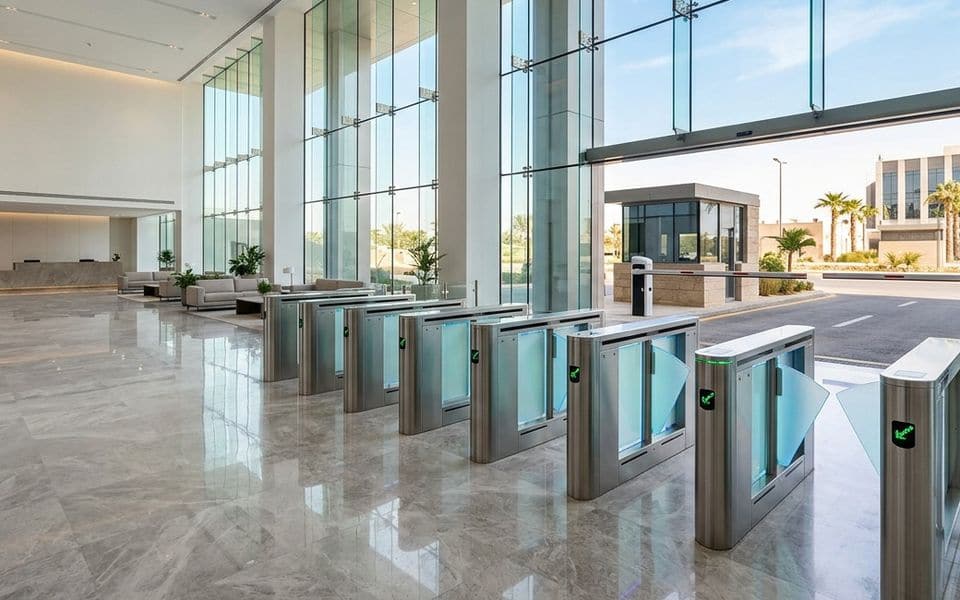
Speed gates and turnstiles are sized from peak-period arrivals, not daily totals. A lobby that receives most of its staff in a 20-minute window needs enough lanes to keep the queue short, plus a wide lane for wheelchairs, deliveries and luggage. Lanes are linked to access control so that a valid credential opens the lane and tailgating is detected.
Automatic doors carry safety obligations: presence sensors that stop and reverse the door, force limits, and break-out or emergency opening on escape routes. Commissioning includes the safety sensor checks and a written record of the settings.
Vehicle barriers, gates and bollards
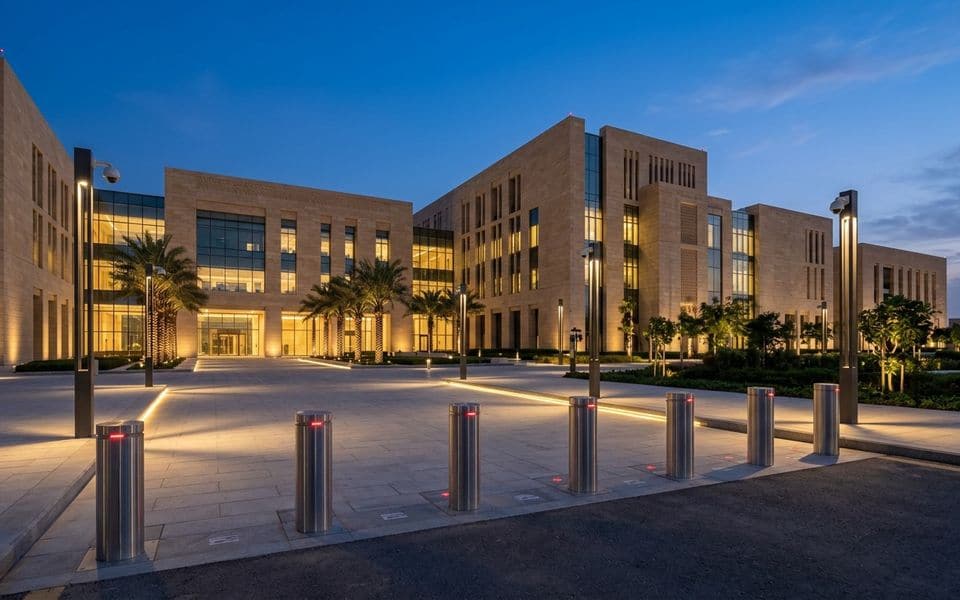
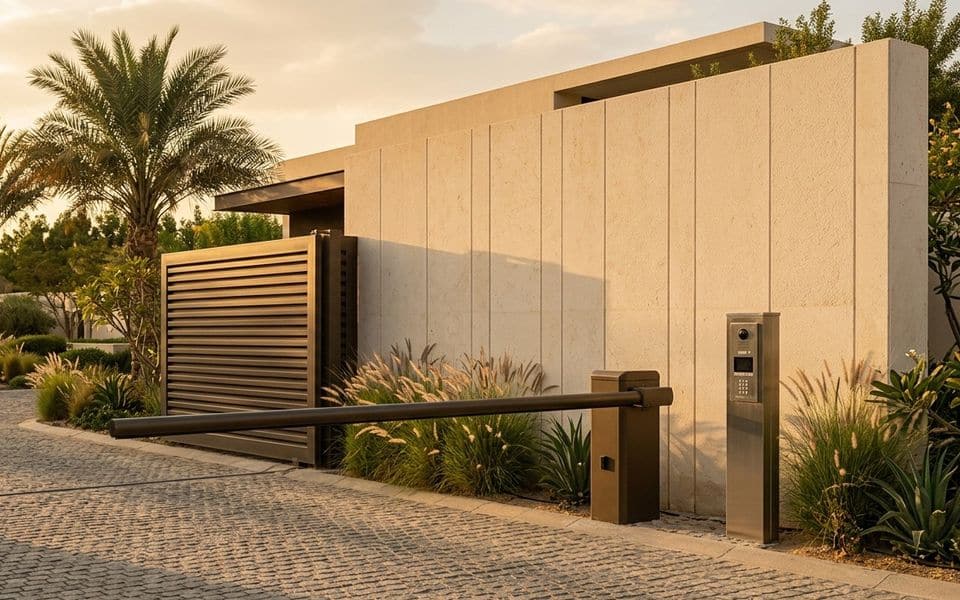
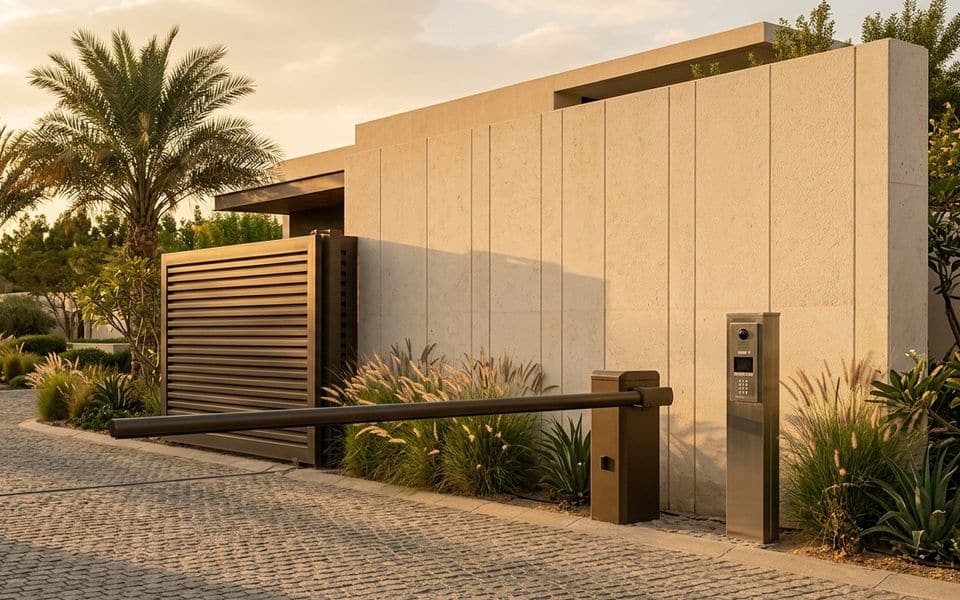
Arm barriers manage flow. Sliding gates and hydraulic bollards stop vehicles. Where hostile vehicles are a risk, crash-rated products tested to recognised standards (such as ASTM F2656 or IWA 14-1) are specified with the rating matched to the vehicle mass and approach speed the site can actually produce. Approach geometry often matters more than the product: a long straight approach lets a vehicle build speed.
Every powered barrier gets safety loops or sensors so it cannot close on a vehicle or person, and a manual release procedure for power failure.
Parking and ANPR
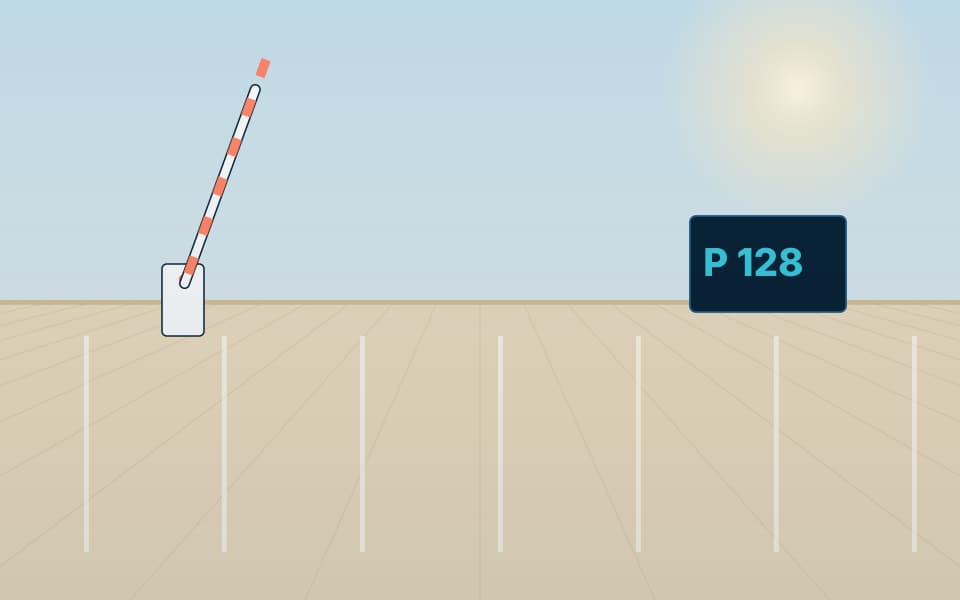
Automatic number plate recognition reads plates at entry and exit for permit holders, visitors and paid parking. Read accuracy depends on camera angle, plate illumination at night, and the plate formats the software is trained on. Saudi plates carry Arabic and Latin characters, so we confirm the engine reads both and test it on real vehicles at the site before go-live.
For paid car parks we design the full flow: entry, space guidance if needed, payment points or ticketless payment, exit, and the back-office reports the operator needs.
Choosing the pedestrian lane type
The lane type sets throughput, security level and cost. The right choice depends on the lobby, the users and whether staff supervise the entrance.
| Option | Strengths | Limits | Typical fit |
|---|---|---|---|
| Swing or flap speed gate | Fast, quiet, wide lanes for wheelchairs, optical sensors detect tailgating | Barriers are not a physical block against a determined person | Offices and towers with reception staff |
| Tripod turnstile | Compact, economical, clear one-at-a-time passage | Slower, awkward with luggage, needs a separate accessible lane | Sports facilities, plants, staff entrances |
| Full-height turnstile | Strongest pedestrian control, resists climbing | Slowest, needs an escape-route solution | Unattended outdoor or high-risk entrances |
| Security revolving or interlocking door | Weather separation and one-person-at-a-time passage | Space, cost and a separate route for deliveries | Premium lobbies, data and control rooms |
| Staffed desk with automatic door | Human judgement for visitors and deliveries | Depends on the person at the desk | Low-volume or mixed-use entrances |
Most buildings combine two: speed gates for the daily population, and one wide, staff-supervised lane for visitors, trolleys and wheelchair users.
Vehicle entrance options
For vehicles the question is whether the device must manage flow, resist force, or both.
| Device | Role | Points to check |
|---|---|---|
| Arm barrier | Flow control at car parks and gatehouses | Arm length against lane width, break-away arm, safety loops |
| Sliding gate | Physical closure of a compound or yard | Run-out space, obstruction detection, photocells |
| Swing gate | Villa and small site entrances | Swing clearance, wind load, motor torque limits |
| Rising bollard | Stops vehicles but opens for authorised traffic | Crash rating, drainage in the pit, emergency lowering |
| Road blocker or wedge | High-security vehicle stop | Foundation depth, utilities under the road, rating tests |
Flow-control devices are not crash barriers. If a rating is needed, it is specified for the device, its foundation and the approach together.
Throughput and queue planning figures
These are planning figures for early design. Real rates depend on the credential type, how familiar users are with the lane and how the site is run, so we confirm them against observation of your own peak period.
- Speed gate lane: roughly 20–30 people a minute with a contactless credential, falling when users hunt for a card or carry luggage.
- Tripod turnstile: roughly 10–20 people a minute.
- Vehicle lane with an arm barrier: roughly 6–10 vehicles a minute with a tag or plate read, and fewer where drivers take tickets or pay.
- Stacking space: allow room before the barrier for the vehicles that arrive in the busiest few minutes, so the queue does not spill onto the public road. A queued car takes about 6 m.
We size from the busiest 15 minutes and add a lane or a fast-pass mode for the peak, rather than designing for the daily average.
Integration with other systems
Entrances are where several systems meet. Access control supplies the credential decision and the audit trail; see the guide to access control types for the credential choices. Video surveillance captures a clear image at each lane, which also settles disputes about who went through. Intercom lets a visitor call the host or the guard at the gate. Power for controllers, loops and safety devices follows the guidance on power continuity, so a short mains failure does not leave a barrier down.
On escape routes, lanes and doors must release when the fire alarm system signals. We coordinate that release interface with the fire alarm contractor, define the signal, and test it at handover; the fire alarm system itself is designed and installed by others. The fail-safe or fail-secure behaviour of each lock is covered in the fail-safe and fail-secure guide.
Commissioning and handover checklist
- Every safety sensor tested: obstruction stops and reverses the door, gate or arm, and force readings are recorded.
- Photocells and loops tested with a car, a van and a motorcycle where the site has them.
- Behaviour checked on power loss, on network loss and on the fire alarm signal, and compared with the written design.
- Manual release tried by the operators, not just by the installer.
- ANPR reads logged over several days across day, night and dust, with the success rate recorded.
- Credentials, plate lists and schedules loaded and checked against the client's rules.
- Camera images at each lane checked for plate and face detail.
- As-built drawings, settings records and operator training delivered.
Common mistakes and how to avoid them
- Sizing from daily totals: a lobby that works at noon is jammed at 8:00. Size from the peak.
- Too little stacking space: the queue blocks the road. Measure the approach at survey stage.
- ANPR camera in the wrong place: a camera aimed across the lane or into low sun misses plates. We choose the angle and illumination for each lane.
- No plan for power cuts: decide whether a gate fails open, fails closed or stays in position, and test it.
- Ignoring tailgating: add detection and an alarm, or keep a guard at the lane.
- Treating a barrier as a bollard: an arm stops nobody who is determined to pass.
Maintenance and testing
Entrances are among the most used equipment on a site, so wear is constant. A planned visit covers safety sensors and force settings, mechanical wear, lubrication, belts, chains and guide rails, loop and photocell alignment, battery and power-supply checks, and the correctness of ANPR reads after any change to lighting or signage. Software updates, plate list clean-up and operator account reviews are done on the same visit. The interval depends on usage; a busy car park needs shorter intervals than a villa gate. Our maintenance service sets the schedule from the actual number of cycles.
Our part, start to finish
What we do on a entrance and parking project
We select the equipment to fit your site, not to clear a stock list. We design the system, install and commission it, and keep it working.
Design & consulting
- Throughput and lane-count calculation
- Door and barrier safety design
- Vehicle threat review where needed
- ANPR camera positions and plate tests
- Integration with access control
Installation
- Gate, door and barrier installation and alignment
- Loop, sensor and safety device set-up
- ANPR tuning on site
- Fail-mode and manual release tests
- Operator training
Maintenance
- Safety sensor and force checks
- Mechanical wear and lubrication
- Loop and ANPR accuracy reviews
- Battery and power checks
- Fast response for blocked entrances
Before you buy
Questions to settle first
These decide cost and performance more than the brand on the box. We work through them with you at survey stage.
- How many people or vehicles arrive in the busiest 15 minutes?
- Which entrances are also escape routes?
- Is there a hostile-vehicle risk, and what approach speed is possible?
- Who are the users: staff, visitors, deliveries, paying public?
- What happens at the barrier during a power cut?
- Do you need parking revenue and occupancy reports?
Frequently asked questions
How many lanes do we need?
Count the people or vehicles arriving in the busiest 15 minutes, divide by the planning rate for the chosen lane type and add one lane for resilience. We confirm the figure against observation of your site.
Can a speed gate stop tailgating?
Optical sensors detect two people passing on one credential and trigger an alarm or close the barrier. They reduce tailgating but are not a physical block, so high-risk areas may need a full-height turnstile or a guard.
Does ANPR work on Saudi plates in sandstorms and at night?
It can, if the camera angle, illumination and software are right. We test with real vehicles at the site in different light before go-live. Heavy dust can reduce read rates, so we plan lens cleaning and review accuracy over time.
What happens to the barrier during a power cut?
That is decided in the design: a battery-backed barrier can finish its cycle and hold its position, and every powered barrier has a manual release. We test the behaviour at handover.
Can the same system serve residents, visitors and paying users?
Yes. Permit holders can pass on tags or plates, visitors on pre-registered plates or a short-term pass, and the public on tickets or ticketless payment. Each group gets its own rules and reports.
Do automatic doors on escape routes need special treatment?
Yes. They must open in an emergency, on power failure or on the fire alarm signal, as the authority requires. We design to those rules, coordinate the release signal with the fire alarm contractor and test it.
Works alongside
Related systems
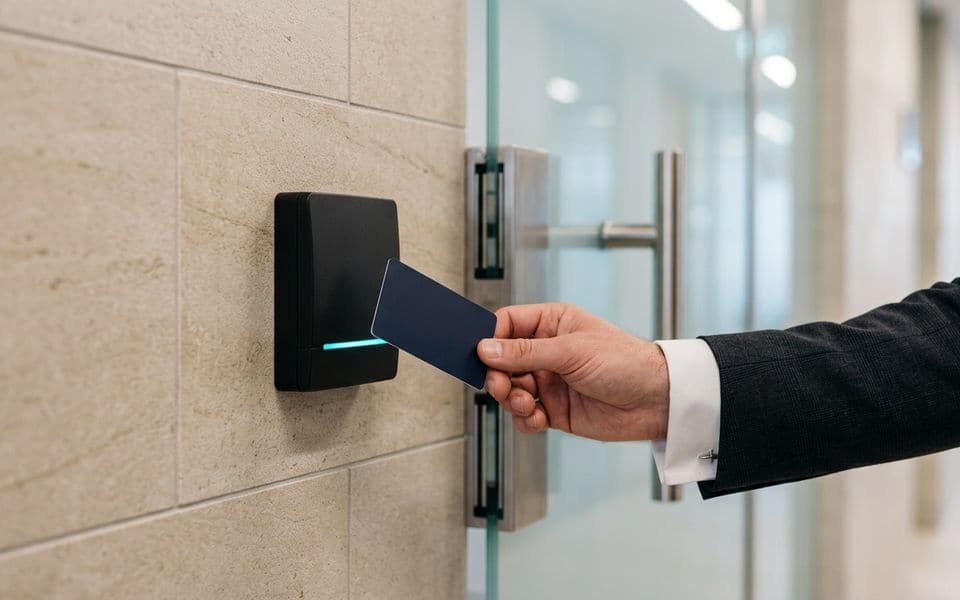
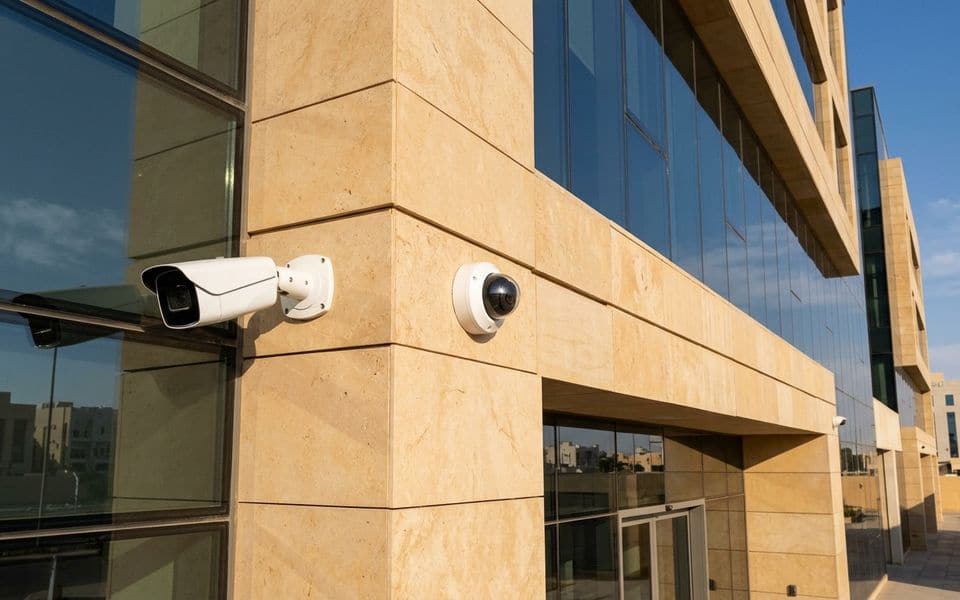
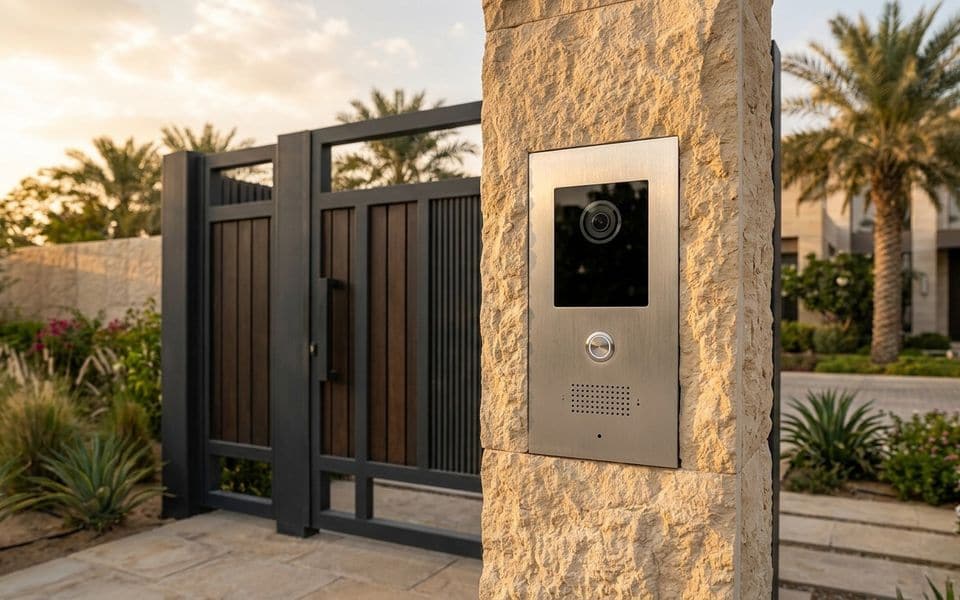
Gallery
Entrances and parking
Illustrations and computer-generated renderings show typical arrangements, not our projects; photographs are credited on the credits page. Select an image to enlarge it.
In Riyadh and across Saudi Arabia
Parking barriers and entrance gates in Riyadh, Jeddah and across Saudi Arabia
Installation of parking barriers and entrance gates for compounds, commercial buildings and hospitals in Riyadh, Jeddah and across Saudi Arabia: barrier arms, number-plate recognition, cards or tickets for visitors, fixed and rising bollards, linked to CCTV with optional payment for public car parks. We install full-height and flap turnstiles for offices and clubs, and car park barriers with licence plate recognition (LPR).
Common questions
Does plate recognition work with Saudi plates?
Yes, cameras and software are set for Saudi plates in Arabic and English, with the right camera angle and lighting.
Barrier or rising bollard?
A barrier manages daily traffic quickly; a rising bollard physically stops a vehicle and is used where ram protection is needed.
What is the difference between a barrier and an automatic gate for parking?
A barrier is an arm that lifts for vehicles; a gate closes the whole entrance. We choose by security level, entrance width and traffic.
Can parking open by reading the number plate?
Yes, with an LPR camera that opens the barrier for registered vehicles and logs entry and exit.
Do you install garage gates with remote opening?
Yes. We install garage gates and link them to remote, card or number-plate opening, with safety sensors that stop the gate closing on a vehicle or person. Remote-controlled parking barriers join the same system.
What are parking bumpers and wheel stops for?
Parking bumpers and wheel stops mark where a wheel should stop and protect walls and equipment from impact. We place them in the parking and barrier layout so traffic keeps flowing.
Manufacturers
Brands commonly specified in Saudi projects
- FAAC
- CAME
- BFT
- Nice
- Magnetic Autocontrol
- Hikvision
Names belong to their owners. Listing a brand shows the systems we design around; it does not mean a partnership or a dealership.