

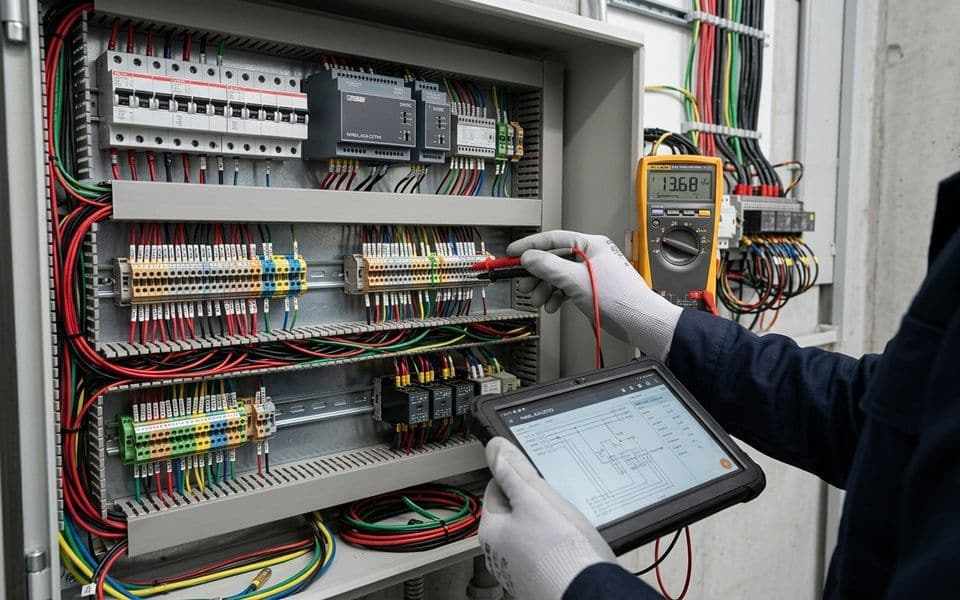

Service 03 · Run · Maintenance division
Maintenance that you can see working
Maintenance runs as its own division, separate from project work. Every contract states what is inspected, how often, how fast we respond, and what you receive afterwards.
Three kinds of maintenance
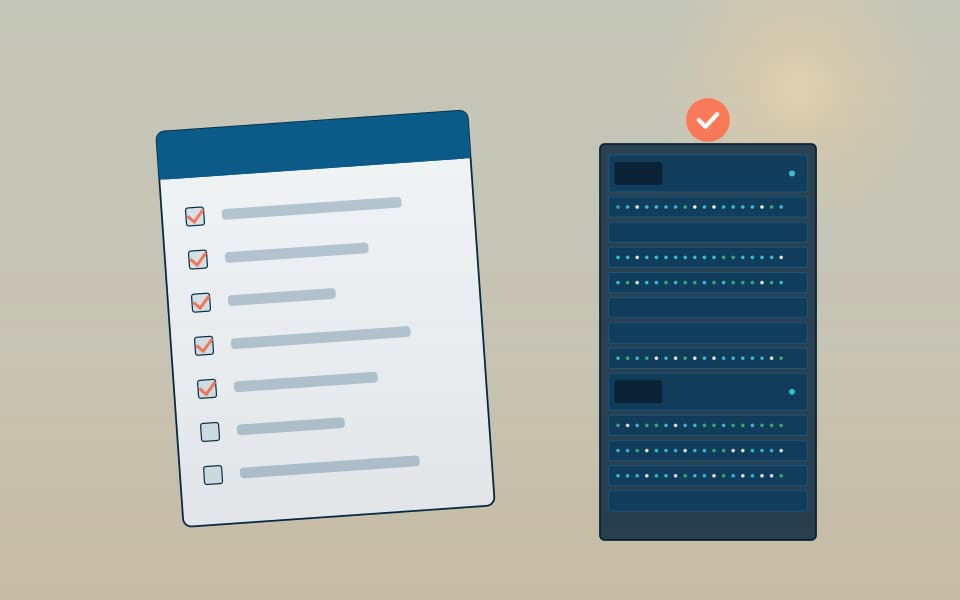
- Preventive maintenance (PPM) is planned work on a fixed schedule: cleaning, inspection, testing and adjustment before something fails.
- Corrective maintenance is the response when something does fail: diagnosis, repair or replacement, and a record of the cause.
- Mandatory maintenance is the work and records that an authority, insurer, landlord or your own policy requires. We keep those records in the format the requirement asks for, so an inspection doesn't become a search through emails.
A typical preventive schedule

Frequencies are set per site, from the manufacturer's guidance, the environment and how critical each system is. A dusty outdoor site needs more frequent camera cleaning than an office floor. This is an example of how a schedule is structured:
| System | Monthly | Quarterly | Annually |
|---|---|---|---|
| CCTV | Recording health, retention check, failed-camera report | Lens and housing cleaning, view checks against plan, focus | Firmware review, disk health trend, full export test |
| Access control | Event log review, offline door check | Door function tests, lock and closer adjustment, reader checks | Fire release test with the fire contractor, user list audit |
| Intrusion & perimeter | Alarm history review | Detector walk tests, tamper checks | Perimeter re-calibration, signalling path test |
| Network & Wi-Fi | Switch and PoE alarms | Port and uplink review, AP health | Firmware, configuration backup, coverage spot check |
| UPS & batteries | Alarm and load check | Room temperature, visual inspection | Battery capacity or impedance test |
What maintenance covers, system by system
The tasks differ by system family. This is what a contract usually spells out for each, preventive first and corrective after.
- Video surveillance: cleaning and view checks, recorder and disk health, retention and export tests, time synchronisation. Corrective work replaces cameras, power supplies, disks and cabling faults, and restores configuration from backup. See video surveillance.
- Access control: door function tests, lock, closer and contact adjustment, reader checks, controller battery and power supply checks, user list audit. Corrective work covers lock and reader replacement and controller recovery. See access control.
- Intrusion and perimeter: walk tests, tamper checks, re-calibration, signalling path tests. Corrective work covers detector and sounder replacement and the diagnosis of nuisance alarms. See intrusion and perimeter detection.
- Network and wireless: switch and access point health, firmware, configuration backups, link and coverage checks. See Wi-Fi and wireless links.
- Power: UPS and battery inspection and capacity tests, load review, environment checks. See UPS and power continuity.
- Intercom and voice: station and handset checks, audio quality, door release tests. See intercom.
A system that mixes these families is covered by a single asset register, so a fault is traced to the right layer first time.
Response targets

Every contract defines priorities and response targets in writing. The targets depend on the site's location and the contract level, so the table below shows the structure rather than a promise for every site.
| Priority | Example situation | What the contract defines |
|---|---|---|
| P1 Critical | Recording stopped, main entrance can't be secured or opened, perimeter system down | Remote response time, on-site attendance time, temporary measure |
| P2 High | Several cameras offline, one controlled door failed | Attendance time and target fix time |
| P3 Normal | Single camera fault, minor defect | Fix within an agreed number of working days |
| P4 Planned | Change requests, moves, additions | Scheduled with the client |
Each fault gets a reference number, a timestamped log from report to closure, and the root cause. Monthly reports show response times achieved against the contract, so you can see whether we kept our word.
Understanding response levels
A response level is easy to misread, so a contract should separate its parts:
- Acknowledgement: time to confirm the fault has been logged and assigned.
- Remote response: time to start diagnosis by remote access where the site allows it.
- On-site attendance: time for an engineer to arrive. It depends on the site's location, so it is set per site and not copied from a standard.
- Temporary measure: a safe interim state while the repair is arranged, such as manual locking of a door.
- Target fix time: the time to restore full function, which may depend on parts.
The contract also states the days and hours the clock runs, what stops it (for example waiting for site access or a client decision), and how a fault is escalated if the target is missed. Ask for these in writing; they matter more than the headline number.
Reporting
Reporting is how maintenance becomes visible. Each visit produces a report with the checks made, the readings, photographs and any defects with a recommended action. Each month the client receives a summary of faults opened and closed, response and fix times compared with the contract, repeat faults, and open recommendations.
Repeat faults are the useful part. A door that fails three times in a quarter points to a cause that a single repair does not remove, and the report says so. A review meeting, as often as the contract states, turns the reports into decisions on replacement, upgrades and budget.
Systems installed by others

We maintain systems we didn't install. Every takeover starts with a condition survey: what exists, what works, what doesn't, and what documentation is missing. We build the asset register, recover or reset administrator access with your authorisation, and agree a list of defects that sit outside the contract until they are fixed. That way the maintenance contract starts from a known baseline.
Audit before taking over
Before we accept a system installed by others, we audit it. The audit covers:
- A device-by-device inventory, checked against any drawings that exist.
- Function of every camera view, door, detector and power supply.
- Recording retention and a real export test.
- Firmware, passwords, administrator accounts and exposure of the system to the network.
- Condition of batteries, cabling, cabinets and environment.
- Missing documentation, licences and support arrangements.
The result is a list of defects, a recommended order to fix them and a decision on what the contract will cover from day one. It also protects both sides: nobody inherits a fault they did not know about.
Spare parts and obsolescence
Every device has a service life. Batteries wear out, fans fail, flash memory ages, and manufacturers retire models and stop issuing firmware. Our maintenance plans for this instead of reacting to it:
- A list of critical spares, held on site or by us, for the parts whose failure stops a system.
- A record of the age and expected life of each asset, shown in the asset register.
- An annual replacement forecast, so budget arrives before the failure does.
- A warning when a product is announced for end of sale or end of support, with a migration option.
Where parts cannot be obtained, we propose a compatible replacement or a phased upgrade, and we tell you what it will do to the rest of the system before work starts.
Contract structure and what to check
Most maintenance disputes trace back to a clause that was not read. Check these points in any maintenance contract, ours included. Our note on planned preventive maintenance contracts goes deeper.
- Scope: an asset register is attached, and anything not on it is outside.
- Visits: the preventive schedule, per system, with the checks listed.
- Response: priorities, response components, hours covered and escalation.
- Parts and labour: what is included, what is charged, and how quotations for parts are approved.
- Exclusions: typically vandalism, misuse, third-party work and damage from power surges. They should be stated, not implied.
- Reports: format and frequency.
- Term and change: duration, how devices are added or removed, review points and how either side ends the contract.
- Access and security: who may enter the site and how credentials for the systems are held.
What you receive
- An asset register for every device under the contract.
- A visit report after each preventive visit: what was checked, results, photos, and defects found.
- A fault log with response and fix times.
- Recommendations for replacement before end-of-life equipment fails.
- Configuration backups kept current.
Spare parts are supplied at cost plus an agreed handling margin or by you, as the contract states. For critical sites we recommend you hold a small stock of critical spares on site.
Maintenance questions we hear often
Do you maintain systems you did not install?
Yes, after the audit described above. The contract starts from a documented baseline so that existing defects are agreed and not argued later.
Is preventive maintenance worth paying for?
It catches the quiet failures: a recorder not recording, a battery that no longer holds charge, a door that no longer latches. These are found at a scheduled visit and not during an incident.
Can maintenance be carried out remotely?
Some of it can: health checks, log reviews, firmware and configuration backups, provided your security policy allows remote access. Cleaning, adjustments and testing need an engineer on site.
What if the equipment is out of production?
We keep the system running as long as sensible, advise on spares, and plan a staged upgrade so the whole system is not replaced in one budget year.
Which cities do you cover?
We work across Saudi Arabia: Riyadh, Jeddah, Dammam and Khobar, Makkah, Madinah and other regions. Attendance times in the contract reflect how far the site is from our engineers.
If a system needs to be designed or rebuilt first, see design and consulting and installation and commissioning.
In Riyadh and across Saudi Arabia
CCTV and security system maintenance contracts in Riyadh, Jeddah and across Saudi Arabia
Maintenance contracts for CCTV, access control, intercom and networks for companies and compounds in Riyadh, Jeddah and across Saudi Arabia: scheduled preventive visits, fault response within the times agreed in the contract, a report for every visit and spare parts as agreed. We maintain systems we did not install after an initial inspection.
Common questions
Do you maintain a system installed by another company?
Yes, after an inspection visit that documents its condition and weak points, followed by a contract proposal that suits it.
What does preventive maintenance include?
Camera cleaning, recording, network and battery checks, door and alarm tests, with a report and recommendations after every visit.